
Medical and diagnostic enzymes are essential components in modern molecular biology workflows. They support nucleic acid amplification, reverse transcription, CRISPR-based detection, lateral flow readout systems and rapid molecular diagnostic assay development.
East-Mab Bio offers a focused range of diagnostic enzyme products and ready-to-use reagent systems for isothermal amplification, LAMP, RT-LAMP, EMA-based amplification, CRISPR-Cas workflows and nucleic acid lateral flow detection. These reagents are designed for research and diagnostic assay development where reliable amplification, sensitive detection and workflow compatibility are important.
What are medical and diagnostic enzymes?
Medical and diagnostic enzymes are biological catalysts used in assays that detect, amplify or process nucleic acids and other biological targets. In molecular diagnostics, these enzymes are commonly used for DNA amplification, RNA reverse transcription, signal generation and target-specific detection.
Common examples include:
- Bst DNA Polymerase for LAMP and isothermal DNA amplification
- M-MLV Reverse Transcriptase for RNA-to-cDNA conversion
- Cas12a and Cas13a enzymes for CRISPR-based nucleic acid detection
- Enzyme-based master mixes for LAMP, RT-LAMP and EMA workflows
These enzyme systems are especially important in molecular testing because they allow specific nucleic acid targets to be detected without always requiring complex thermal cycling equipment.
Isothermal amplification reagents
Isothermal amplification is a nucleic acid amplification approach performed at a constant temperature. Unlike PCR, which requires repeated temperature cycling, isothermal amplification can be performed using simplified heating conditions.
East-Mab Bio provides several liquid-format isothermal amplification kits, including:
| Product | Cat# | Size | Application |
|---|---|---|---|
| EMA Kit Liquid | EA0101 | 50 T | EMA |
| RT-EMA Kit Liquid | EA0102 | 50 T | EMA |
| EMA Exo Kit Liquid | EA0103 | 50 T | EMA |
| RT-EMA Exo Kit Liquid | EA0104 | 50 T | EMA |
| EMA Nfo Kit Liquid | EA0105 | 50 T | EMA |
| RT-EMA Nfo Kit Liquid | EA0106 | 50 T | EMA |
These kits are suitable for assay developers working on nucleic acid amplification systems, RNA detection workflows and rapid molecular testing formats.
LAMP and RT-LAMP master mixes
Loop-mediated isothermal amplification, commonly known as LAMP, is widely used for rapid DNA amplification. RT-LAMP combines reverse transcription with LAMP, making it suitable for RNA targets.
East-Mab Bio’s LAMP-related products include:
| Product | Cat# | Size | Application |
|---|---|---|---|
| LAMP Colorimetric Master Mix, red to yellow | EA0201 | 50 T | LAMP |
| LAMP Fluorescent Master Mix Liquid | EA0202 | 50 T | LAMP |
| RT-LAMP Colorimetric Master Mix, red to yellow | EA0204 | 50 T | LAMP |
| RT-LAMP Fluorescent Master Mix Liquid | EA0205 | 50 T | LAMP |
Colorimetric LAMP master mixes are useful when visual endpoint detection is required, while fluorescent master mixes are suitable for real-time amplification monitoring.
LAMP fluorescent master mix validation
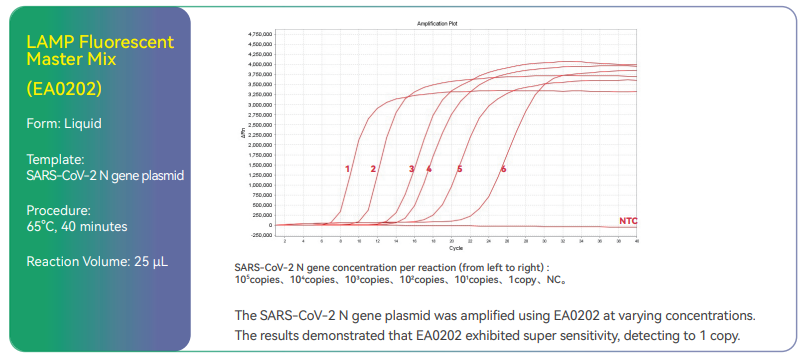
According to the East-Mab Bio validation data, the LAMP Fluorescent Master Mix EA0202 was tested using a SARS-CoV-2 N gene plasmid template. The reaction was performed at 65°C for 40 minutes in a 25 µL reaction volume. The validation example reports detection down to 1 copy of the SARS-CoV-2 N gene plasmid.
This makes EA0202 relevant for research workflows involving sensitive DNA target amplification, assay development and molecular diagnostic reagent evaluation.
RT-EMA Nfo Kit for RNA amplification workflows
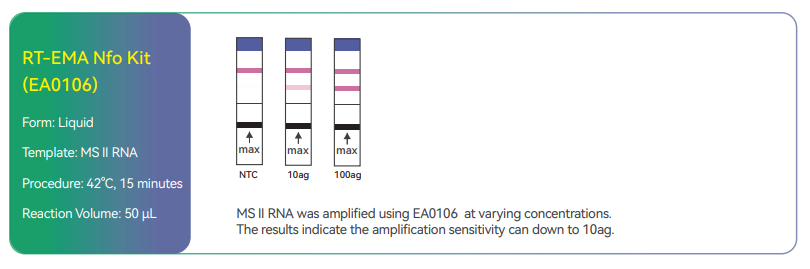
The RT-EMA Nfo Kit EA0106 is presented as a liquid-format reagent for RNA amplification workflows. In the supplier validation example, MS II RNA was used as the template. The reaction was performed at 42°C for 15 minutes in a 50 µL reaction volume, with reported sensitivity down to 10 ag.
This type of reagent is relevant for workflows where RNA target detection, rapid amplification and lateral flow-style readout may be required.
CRISPR-Cas enzymes for molecular detection and gene editing research
CRISPR-Cas enzymes are increasingly used in molecular biology and diagnostic research because of their sequence-guided nucleic acid recognition properties.
East-Mab Bio lists the following CRISPR-Cas enzymes:
| Product | Cat# | Size | Concentration | Application |
|---|---|---|---|---|
| LbCas12a | EB0502 | 10 µL, 100 µL | 10 pmol/µL | Gene Editing |
| LwaCas13a | EB0505 | 10 µL, 100 µL | 10 pmol/µL | Gene Editing |
Cas12a is commonly associated with DNA-targeting CRISPR systems, while Cas13a is associated with RNA-targeting CRISPR systems. These enzymes can support CRISPR-based assay development, target recognition studies and molecular detection research.
Related diagnostic enzyme products
East-Mab Bio also lists several related products for amplification, reverse transcription and lateral flow detection:
| Product | Cat# | Size | Concentration | Application |
|---|---|---|---|---|
| Bst DNA Polymerase | EB0201 | 100 µL | 10 U/µL, 250 U/µL | LAMP |
| M-MLV Reverse Transcriptase | EB0118 | 100 µL | 200 U/µL | Reverse Transcription |
| Nucleic Acid Lateral Flow Strip | NAS01A | 10 T, 50 T | LFT | |
| Dualplex Nucleic Acid Lateral Flow Strip | NAS02A | 10 T, 50 T | LFT |
These products can be used as part of molecular diagnostic assay development workflows, especially where amplification and visual detection are combined.
Applications of medical and diagnostic enzymes
Medical and diagnostic enzyme reagents are used in several molecular biology and assay-development workflows, including:
- Isothermal DNA amplification : For rapid amplification of DNA targets without thermal cycling.
- RNA target detection : Using reverse transcription reagents or RT-LAMP systems.
- LAMP assay development : For colorimetric or fluorescent detection of nucleic acid targets.
- CRISPR-Cas detection research : Using Cas12a or Cas13a enzymes for sequence-guided molecular recognition.
- Lateral flow nucleic acid detection : For visual readout formats in assay development.
- Point-of-care molecular testing research : Where simplified workflows, constant-temperature amplification and visual detection may be desirable.
LAMP vs RT-LAMP: what is the difference?
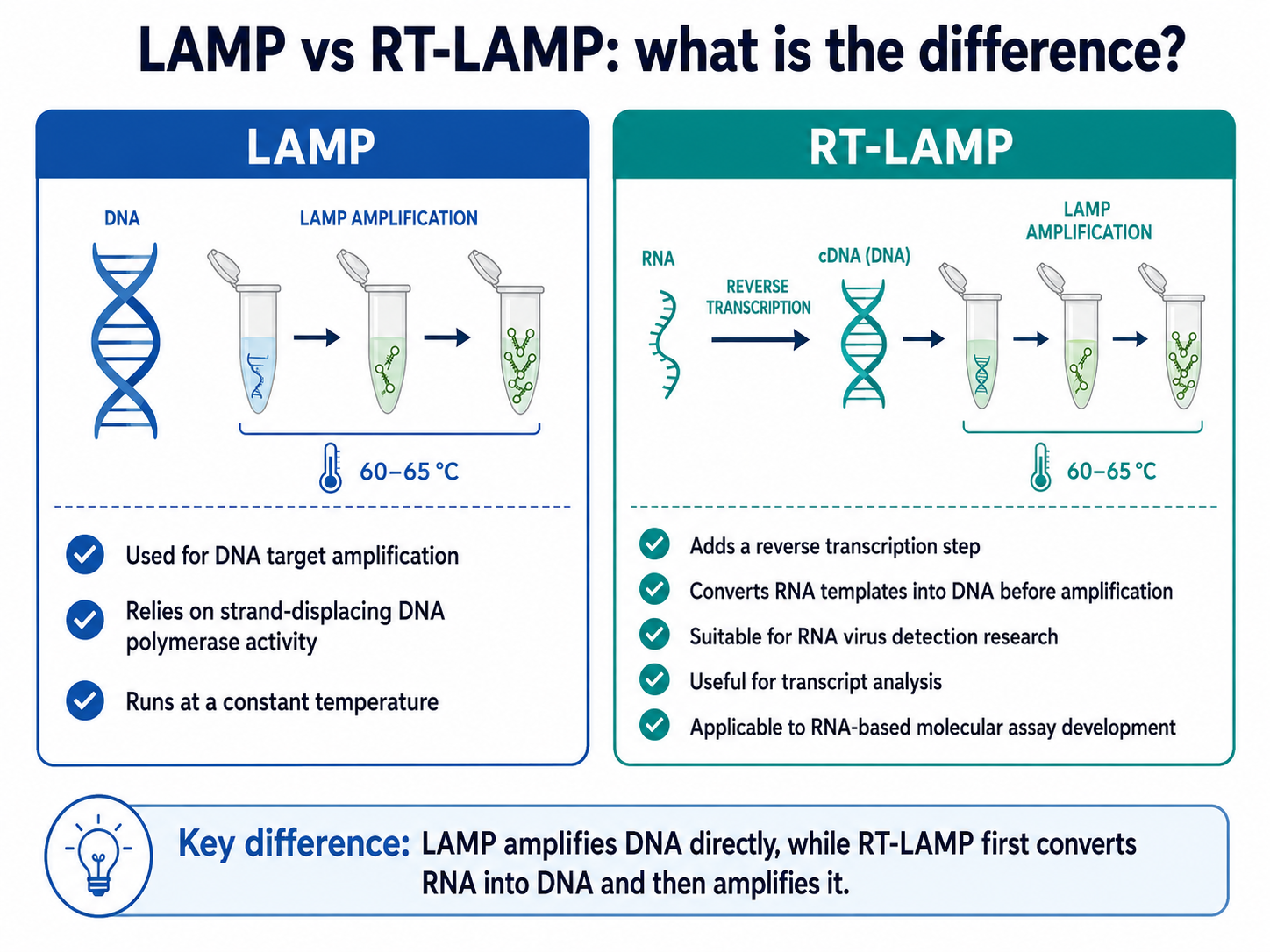
LAMP is used for DNA target amplification. It relies on strand-displacing DNA polymerase activity and runs at a constant temperature.
RT-LAMP adds a reverse transcription step, allowing RNA templates to be converted into DNA before amplification. This makes RT-LAMP suitable for RNA virus detection research, transcript analysis and RNA-based molecular assay development.
For example:
| Workflow | Target type | Typical use |
|---|---|---|
| LAMP | DNA | DNA pathogen target detection, plasmid detection, assay development |
| RT-LAMP | RNA | RNA virus research, transcript detection, RNA assay development |
| CRISPR-Cas12a | DNA-associated detection | DNA target recognition research |
| CRISPR-Cas13a | RNA-associated detection | RNA target recognition research |
| Lateral flow detection | Amplified nucleic acid products | Visual readout assay formats |
Why these reagents matter for diagnostic assay development
Diagnostic enzyme systems can reduce workflow complexity and improve assay flexibility. Ready-to-use master mixes may help standardize amplification reactions, while individual enzymes such as Bst DNA Polymerase and M-MLV Reverse Transcriptase allow researchers to build customized protocols.
For researchers developing molecular assays, product selection depends on:
- Target type: DNA or RNA.
- Detection format: fluorescent, colorimetric or lateral flow.
- Workflow speed.
- Reaction temperature.
- Required sensitivity.
- Compatibility with downstream detection methods.
- Whether CRISPR-Cas detection is part of the assay design.
FAQ
What enzyme is used in LAMP?
=> LAMP commonly uses a strand-displacing DNA polymerase such as Bst DNA Polymerase. East-Mab Bio lists Bst DNA Polymerase as a related product for LAMP applications.
What is RT-LAMP used for?
=> RT-LAMP is used for RNA target detection. It combines reverse transcription with loop-mediated isothermal amplification, making it useful for RNA virus research and RNA-based molecular assay development.
What is the difference between LAMP and PCR?
=> PCR requires repeated thermal cycling, while LAMP is performed at a constant temperature. This makes LAMP attractive for simplified molecular detection workflows.
What are CRISPR-Cas enzymes used for?
=> CRISPR-Cas enzymes such as Cas12a and Cas13a are used in gene editing research and nucleic acid detection workflows. Cas12a is often associated with DNA-targeting systems, while Cas13a is associated with RNA-targeting systems.
What is a nucleic acid lateral flow strip?
=>A nucleic acid lateral flow strip is a visual detection format used to detect amplified nucleic acid products. It is commonly used in rapid assay development and point-of-care research formats.